

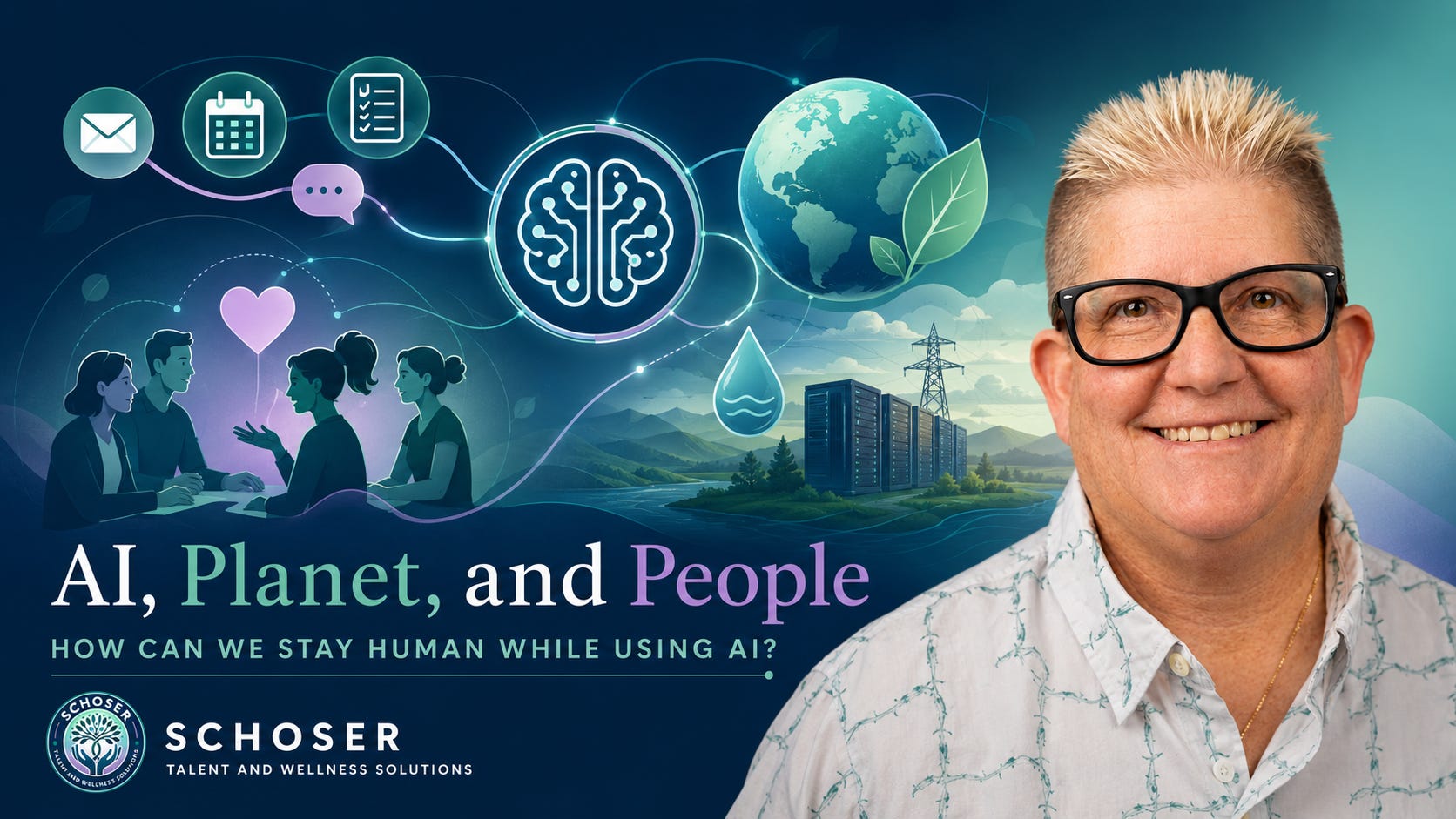
Yesterday, I spoke for ninety minutes to business owners at Tompkins Chamber about AI. I went into the conversation with sufficient anxiety that my stomach made its feelings known, but it went well. And the conversation was about practical AI, AI that enables businesses to run on a regular Tuesday, not the grand, world-taking, passive-income-generating variety of AI that is more common in the discussions.
Two participants asked me pointed questions, and I am grateful for them as they were far more important questions than a lot of what appeared in my slide deck.
“What is this doing to the planet?”
One of them is a climate scientist. His questions revolve around electricity, water, data centers, and the idea that every AI-generated image takes a certain amount of water.
I was not defensive here. There is a valid point, and it is real. According to the International Energy Agency, electricity demand from data centers increased by 17% in 2025, and the growth of AI-powered data centers was particularly fast. Meanwhile, the electricity needed to perform every single individual AI task keeps going down with advancing technology.
They can both be true at the same time, and this issue is more complex than the “AI is bad” claim.
I stressed my response to the water consumption calculation. Even if it is a simple one-line statistic, it is not universal, as electricity consumption for generating one image varies by 46x with different models, hardware, and conditions in 2025 according to the study. Water consumption depends on the cooling technology and climate, which is why the Department of Energy treats it as a variable rather than a conversion rate. I’d rather communicate the nuance than lie.
I did some due diligence on my end as well. I have been using ChatGPT extensively for over three years for writing, planning, brainstorming, and running my business. I do not use the heaviest computation model when it is not needed, and nothing works in the background. Based on the benchmark by Sam Altman, which is confirmed to be accurate by Epoch AI’s independent testing, one day of productive use (50-100 prompts, a few images) requires about 0.02 to 0.04 kWh, which is only a very small fraction of the 28 kWh that a typical U.S. household uses per day according to EIA.
This is not meant as an excuse. This is meant to provide some context. A busy brainstorming session is not the same as running a hyperscale data center. According to the IEA, the typical AI-driven data center requires electricity consumption equivalent to 100,000 homes, and the new largest centers being built now require even more. It is not helpful to discourage someone from writing an email, just like it is not helpful to act as if this debate is meaningless. The AI use is truly modest on the individual level; the scale is large on the part of companies building the infrastructure—not on the part of someone writing an email for their nonprofit organization’s newsletter.
Afterward, it came down to the job losses question.
The second participant’s concerns did not relate to water, but to people. Her friends lost their jobs as companies shifted to AI for marketing, and she was understandably distressed by this shift.
I communicated my belief that many companies that adopted AI fully are already scaling down, as this technology is not yet good enough for unsupervised use and human input is still needed in such areas as the voice of a brand, timing, whether this joke plays or backfires, and comprehension of the meaning behind a message from a client. This is real and visible publicly.
Is AI taking jobs? Yes, sometimes. Denying it would be disingenuous and would destroy credibility. Research paints a more complex picture than replacement, though. The International Labour Organization estimates that about a quarter of all jobs in the world have some exposure to generative AI, and their researchers conclude that the transformations are more likely than replacement because most jobs consist of activities requiring human input—judgment, relationship, context, responsibility.
Let’s take marketing for example. AI is great at drafting, creating multiple headline variations, and scheduling content in a calendar. AI is not able to read the room, to make the right ethical decision, or understand the customer. The main question is not what AI can replace in a job, but what parts of a job AI can automate and what happens with the freed time. If it goes back to people to do more valuable work, then AI is good. If it is used as an excuse to get rid of a person, it is the management decision, not AI’s. I encourage business leaders to be honest with this choice.
This does not mean that creators' worries go unanswered—open questions about training data, compensation, copyright, and unfair competition between AI-produced content and human work remain unresolved. They are not anti-AI worries—they are worries about fairness, and they should be answered with something more than indifference.
My position
Despite the discussion yesterday, my enthusiasm for AI has not decreased in any way. It has made it stronger, actually.
AI has never felt grief, love, or a struggle with calculating payroll in the middle of the night. AI can simulate aspects of all of these things but cannot experience them. This is not a criticism of the technology—it is the reality. AI is a powerful tool, not a replacement for the whole team.
One can use AI and be concerned about the planet, support the people who trained the technology and the people who will have to transform their jobs, and respect the power of this technology while holding the companies producing it accountable. It is not contradictory—it is responsible use.
I am not trying to convince every participant in that room to adopt AI. Instead, I hope that I gave them enough information to make an informed decision—about what AI can do and what it cannot, about where it can save time and where human presence is irreplaceable.
Hence, the key question that I would like to explore further is not how sophisticated machines can be, but how human we can stay while using them.
P.S. I turned the above into a companion piece—a complete list, a breakdown for enterprises vs individuals, and a comparison of responsible vs irresponsible use of AI. Access it via the link below to have a practical, reference-ready version: AI Without the Hype.
Sources
[^1]: International Energy Agency, Key Questions on Energy and AI (2026) — data center electricity demand rose 17% in 2025, with AI-focused centers growing even faster. iea.org
[^2]: Shullani et al., The Hidden Cost of an Image: Quantifying the Energy Consumption of AI Image Generation (arXiv, 2025) — up to a 46x variation in energy use among image-generation models. arxiv.org
[^3]: U.S. Department of Energy, Federal Energy Management Program — guidance on data center cooling and water efficiency; water use depends on cooling system design, climate, and location. energy.gov
[^4]: Sam Altman (OpenAI), The Gentle Singularity blog post (2025) — citing ~0.34 Wh per average ChatGPT query; independent modeling from Epoch AI landed near ~0.3 Wh for GPT-4o. epoch.ai
[^5]: U.S. Energy Information Administration — average U.S. residential customer used 865 kWh/month in 2024, roughly 28–29 kWh/day. eia.gov
[^6]: International Energy Agency, Energy and AI — a typical AI-focused data center consumes as much electricity as 100,000 households; the largest under construction may use 20x that. iea.org
[^7]: International Labour Organization & NASK, Generative AI and Jobs: A Refined Global Index of Occupational Exposure (2025) — roughly 1 in 4 jobs globally has some exposure to generative AI; researchers conclude transformation is more likely than replacement. ilo.org
very well said Gretchen - i personally think that the people in power are too blame and not the AI itself. I do think that data centers should not be placed in populated areas near homes or farms due to the loud noises they generate and emf they give off.
I personally believe the environment issue comes down to our politicians at the local, state and federal level. They are in bed with AI companies and allow them to build these data centers while ignoring concerns from citizens and bypassing normal regulations and straining local power grids and water systems.
I believe that if a company wants to build an AI data center they should be forced to invest in renewable energy, consider different cooling methods and also be "forced" to invest in the protection of the local peoples water source if they plan to use it and it should be mathematically calculate to offset their usage to not affect local citizens heavily. Just like in many other industries in the USA unfortunately our politicians at the local, state, and federal level are the root cause of most problems. (this was reponse was personally typed by me and was not ai generated)
This was so helpful! Thanks so much for the breakdown and sharing the nuance that's involved.